
Choosing the right belling machine can directly affect pipe production efficiency, labor cost, product quality, and long-term business competitiveness. For PVC, PP, and PE pipe manufacturers, the decision often comes down to one key question: should you invest in an automatic or semi-automatic belling machine?
What Is a Belling Machine?
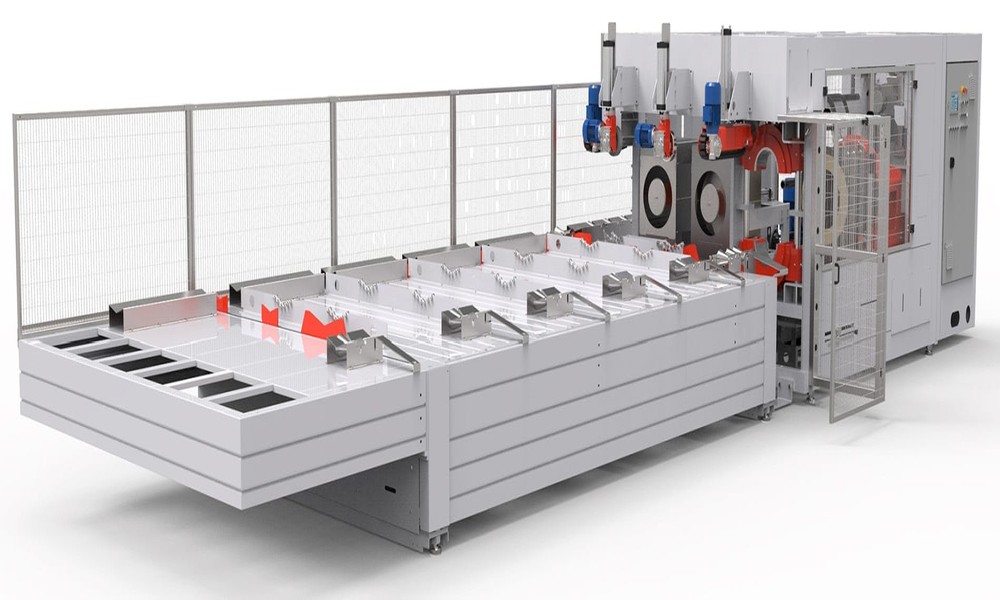
A belling machine is used to form sockets at the end of plastic pipes, allowing pipes to connect securely during installation. It is widely used in drainage pipes, water supply pipes, electrical conduit pipes, and infrastructure piping systems.
In modern plastic pipe machinery production lines, belling machines are often placed after extrusion, cooling, hauling, cutting, and stacking processes. Their role is to improve pipe connection accuracy, reduce manual processing, and support standardized mass production.
What Is an Automatic Belling Machine?
An automatic belling machine performs most working steps automatically, including pipe feeding, heating, socket forming, cooling, and pipe discharge. It can be connected to the extrusion line for a fully continuous production flow.
This type of machine is suitable for manufacturers with stable orders, high output requirements, and strict product consistency standards. Once the machine parameters are set, it can run with minimal manual intervention.
What Is a Semi-Automatic Belling Machine?
A semi-automatic belling machine still uses mechanical heating and forming systems, but some steps require manual operation. For example, workers may need to load pipes, adjust positioning, or remove finished pipes after forming.
This type is often chosen by small and medium-sized pipe factories, especially when production volume is moderate or product specifications change frequently.
Key Differences Between Automatic and Semi-Automatic Belling Machines
1. Production Efficiency
Automatic machines are built for uninterrupted, high-speed operation. They can match extrusion line output and reduce waiting time between pipe cutting and socket forming. This makes them ideal for factories producing large quantities of standard pipe sizes.
Semi-automatic machines are slower because manual handling is required. However, for smaller batches or customized pipe orders, the lower speed may still be acceptable.
2. Labor Requirements
Automatic belling machines reduce dependence on manual labor. One operator can often monitor the machine and adjust parameters when needed. This helps reduce labor cost and improves production stability.
Semi-automatic machines require more operator involvement. They are simpler to use but rely more on operator skill and focus. If labor cost is low and production demand is not very high, this can still be a practical choice.
3. Product Consistency
Automatic systems offer better consistency because heating time, forming pressure, cooling time, and pipe positioning are controlled by the machine. This reduces human error and improves socket quality.
Semi-automatic machines can also produce qualified sockets, but results may vary more depending on operator experience. For businesses serving high-standard engineering or municipal projects, consistency is especially important.
4. Investment Cost
Semi-automatic machines usually have a lower purchase cost. They are suitable for new factories, small workshops, or businesses testing a new pipe product.
Automatic machines require a higher initial investment, but they can reduce labor cost, improve output, and support long-term production growth. For manufacturers with stable demand, the higher cost may be recovered through better efficiency.
5. Flexibility
Semi-automatic machines are often more flexible for small batches and frequent size changes. Operators can adjust production more easily when switching between different pipe specifications.
Automatic machines are better for standardized production. They can also handle different pipe sizes, but changeover may require more setup and adjustment.
Which Machine Is Better for Your Business?
Choose a semi-automatic belling machine if your factory has limited budget, smaller production volume, frequent product changes, or less need for full-line automation. It offers a cost-efficient option for entry-level production and flexible orders.
Choose an automatic belling machine if your factory needs high output, stable quality, lower labor dependence, and better integration with the extrusion line. It is more suitable for growing pipe manufacturers, large-scale production plants, and businesses targeting engineering or infrastructure markets.
Final Recommendation
There is no single best choice for every pipe business. The ideal machine choice depends on production scale, budget, labor costs, pipe size range, and future expansion plans.
For small or developing factories, a semi-automatic model can reduce investment pressure while meeting basic production needs. For manufacturers focused on efficiency, quality consistency, and long-term competitiveness, an automatic solution is usually the better choice.
Before purchasing, evaluate your current orders, expected output, available operators, and product standards. A well-matched belling machine can improve production efficiency, reduce defects, and help your pipe business build stronger market competitiveness.