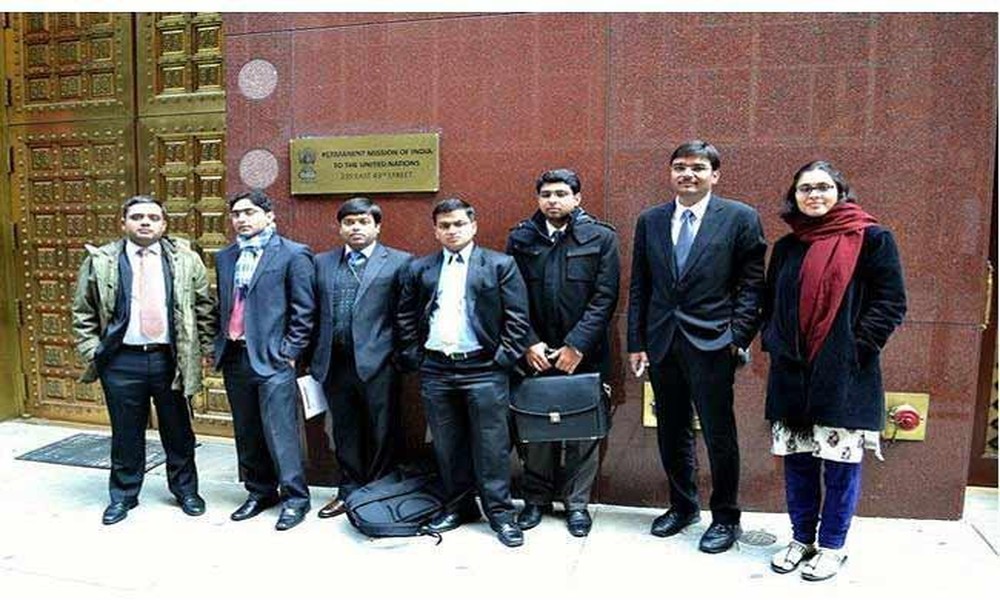

A career FSO returning to Foggy Bottom from a hardship post in West Africa receives an Employee Evaluation Report that, for the first time in fifteen years, contains a low-end ranking. A USAID Foreign Service Officer learns that her selection board recommendation has placed her on a list for selection out. A Diplomatic Security Special Agent finds himself the subject of an internal investigation that triggers a security clearance review and a proposed adverse action. None of these matters proceed through the MSPB. The Foreign Service operates under its own personnel statute, with its own grievance process, its own selection-out machinery, and its own appellate forum. A Washington DC federal employee attorney who works on Foreign Service matters can map out the framework before procedural windows close on the unique appeal posture diplomatic personnel face.
Why Foreign Service Personnel Aren’t Title 5 Federal Employees
The Foreign Service Act of 1980, Public Law 96-465, codified at 22 U.S.C. § 3901 et seq., created a distinct personnel system for U.S. diplomatic, consular, and development personnel. The Act covers Foreign Service Officers (FSOs), Foreign Service Specialists (the technical and support workforce), and Foreign Service Generalists across the State Department, USAID, the Foreign Commercial Service at Commerce, the Foreign Agricultural Service at USDA, and the U.S. Agency for Global Media.
Foreign Service personnel are not Title 5 employees. The General Schedule does not apply to them. Chapter 75 of Title 5 does not govern their discipline. The MSPB has no jurisdiction over their adverse actions. The framework is entirely separate, with its own pay system (the Foreign Service Schedule), its own promotion mechanism (the selection board process), its own assignment system (the bidding process), and its own grievance process.
What does carry over from the broader federal sector framework: Title VII, the ADEA, the Rehabilitation Act, and the federal sector EEO process at 29 C.F.R. Part 1614 apply to discrimination claims. Whistleblower protections under the WPA and WPEA apply, with the Office of Special Counsel having jurisdiction. The Foreign Service has its own collective bargaining framework under chapter 10 of the Foreign Service Act, with the Foreign Service Labor Relations Board playing a role analogous to the FLRA.
The Foreign Service Grievance Board
The Foreign Service Grievance Board (FSGB) is the central appellate body for Foreign Service personnel matters. Established under 22 U.S.C. § 4135, the FSGB is an independent body whose members are appointed by the Secretary of State from outside the Foreign Service. It hears grievances on a wide range of personnel actions and operates as the rough equivalent of the MSPB for the diplomatic workforce.
The FSGB’s jurisdiction extends to:
- Adverse actions including separation, suspension over five days, reduction in grade, and reduction in pay
- Performance evaluation disputes (challenges to Employee Evaluation Reports)
- Selection-out determinations and the underlying low-rankings that produce them
- Assignment disputes in defined circumstances
- Allowance, differential, and pay disputes
- Tenure decisions
- Discipline imposed under the Foreign Service Act
The grievance process begins at the agency level. Under 22 U.S.C. § 4131, an aggrieved Foreign Service member files a grievance with the agency, which has 90 days to render a decision. If unresolved, the member can appeal to the FSGB within 60 days of the agency decision (or after 90 days if the agency hasn’t acted).
The FSGB’s procedures include written submissions, document production, witness interviews, and hearings in some cases. Decisions are rendered in writing and become part of a public record (with appropriate redactions for classified or personally sensitive material). The FSGB’s published decisions at fsgb.gov are an underused resource for understanding how arguments are received in this forum.
Selection-Out and Why the EER Matters
Selection-out is a feature of the Foreign Service personnel system that has no real Title 5 analog. Foreign Service members are reviewed annually by selection boards, which produce ranked lists used for promotion decisions and, for those near the bottom, for separation from the Service.
The relevant statutory framework lives at 22 U.S.C. §§ 4007-4011. Members can be selected out for failure to meet the standards of their class (low-ranking selection-out), for failure to be promoted within prescribed time limits in class (TIC selection-out), or for failure to receive tenure during the limited career-candidate period.
Each route has its own procedural framework, but the common foundation is the Employee Evaluation Report. The EER is the central document in any Foreign Service career, and challenges to selection-out almost always begin with challenges to the EERs that supported the low ranking.
A grievance challenging an EER must typically be filed within a defined period after the report becomes final. Substantive grounds include factual inaccuracies, procedural defects in how the report was prepared, improper falsely prejudicial material, and reports that fail to comply with the Foreign Affairs Manual’s EER requirements.
A successful EER grievance can produce removal of the report from the file, reranking by a reconstituted selection board, and reversal of a selection-out decision. Filed late or filed without sufficient evidentiary support, the same grievance may produce nothing.
Discipline, Suspension, and Separation
For misconduct-based actions, the framework runs parallel to MSPB Chapter 75 procedures but with Foreign Service-specific overlays. The Bureau of Human Resources at State (or the equivalent at USAID and other Foreign Service agencies) initiates the action with a notice of proposed adverse action. The Foreign Service member has a defined period to reply, typically 30 days.
A deciding official issues a final decision. The member can grieve to the agency, then to the FSGB, with the FSGB conducting de novo review of the underlying action.
Suspensions of five days or less are not grievable. Suspensions over five days, separation for cause, and reductions in grade or pay all are.
Security clearance suspension and revocation present a parallel issue. The State Department’s Bureau of Diplomatic Security handles clearance matters, and the procedural framework for clearance-based actions runs through internal panels with limited external review under Department of the Navy v. Egan, 484 U.S. 518 (1988). For Foreign Service members whose positions are entirely dependent on a clearance, a clearance suspension can functionally end the career even when no FSGB-reviewable adverse action has been formally taken.
Discrimination, Retaliation, and EEO
The federal sector EEO process applies to Foreign Service members. The 45-day deadline to contact an EEO counselor at the State Department’s Office of Civil Rights or the equivalent office at USAID applies. Formal complaints, agency investigations, and EEOC AJ hearings proceed through the same 29 C.F.R. Part 1614 framework that applies to other federal workers.
Whistleblower complaints can be filed with OSC, with the WPA’s Individual Right of Action mechanism available after OSC closure. The Foreign Service has its own internal Inspector General offices (State OIG, USAID OIG) that handle disclosure of fraud, waste, and abuse.
Mixed cases involving both an FSGB-grievable action and a discrimination claim raise forum coordination issues that don’t appear in standard MSPB practice. Foreign Service-specific case law on the interaction between FSGB grievances and EEO complaints develops slowly and rewards counsel familiar with both processes.
Practical Steps When a Notice or Low EER Arrives
Save every document related to the proposed action, the EER at issue, and any underlying communications about the matter. Preserve emails, cable traffic where appropriate (with classification handling), and contemporaneous notes.
Identify the procedural framework. Determine whether the matter is a grievable adverse action under chapter 11 of the Foreign Service Act, an EER challenge, a selection-out determination, a discrimination claim, or a clearance issue, and track the deadlines for each.
Don’t sign any settlement, separation, or curtailment agreement without counsel review. Foreign Service settlement language often interacts with annuity calculations, FSPS retirement timing, and post-employment restrictions in ways that aren’t apparent on first reading.
Engage AFSA representation where applicable. The American Foreign Service Association represents most Foreign Service members in grievance matters and provides services that complement private counsel.
Foreign Service members across State (Foggy Bottom and posts abroad), USAID, the Foreign Commercial Service, the Foreign Agricultural Service, and the Agency for Global Media all operate under this framework with agency-specific implementing regulations.
For background, fsgb.gov publishes FSGB decisions and procedural rules, state.gov publishes the Foreign Affairs Manual sections governing personnel matters, and 22 U.S.C. §§ 3901-4172 along with 22 C.F.R. Part 901 contain the substantive references.
Talk to a Washington DC Federal Employee Attorney Who Knows the Foreign Service Framework
Foreign Service personnel matters reward early counsel involvement because the procedural choices made in the first weeks (the agency-level grievance, the EER challenge, the response to a notice of proposed action) often determine whether the case is preserved or quietly forfeited. A Washington DC federal employee attorney who has handled FSGB cases, EER grievances, selection-out challenges, Diplomatic Security clearance matters, and Foreign Service EEO complaints can help diplomatic personnel preserve options the procedural framework was designed to provide. If you’re a Foreign Service member facing an adverse action, a low EER, a selection-out determination, or a clearance issue, contact counsel before the next deadline runs.